
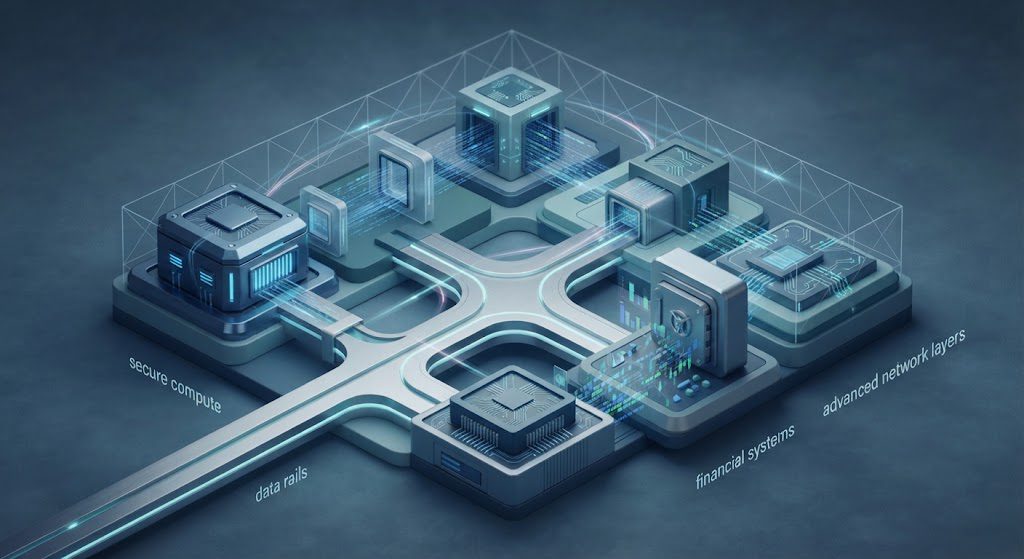
AI is moving out of the demo layer and into the infrastructure beneath government, finance, data and networks. That changes what matters, and what can break.
The UAE’s most important AI story this summer is not a model launch.
It is the infrastructure forming underneath the models.
Over the past few months, the country has moved on several fronts that look separate when viewed as individual announcements: a federal framework for agentic AI, a new authority combining AI, data and digital-government responsibilities, sovereign GPU capacity for enterprises and government, formal AI governance in finance, a regulated Open Finance API layer, wider distribution of market data, and new connectivity infrastructure designed for increasingly intelligent networks.
Taken together, they point to a more consequential transition. The UAE is not only trying to put AI inside existing services. It is beginning to redesign the rails those services run on so software can interact with other software more directly, more securely and with clearer rules.
That is the prerequisite for an agentic economy.
The phrase should not be confused with an economy running autonomously. The UAE is not there, and neither is anyone else at national scale. The signal is that the technical and institutional layers required for greater machine participation are being assembled at the same time.
From digital government to executable government
The clearest expression of the shift comes from government itself. In April, the UAE announced a framework intended to transform 50% of government sectors, services and operations to agentic AI models within two years. The ambition goes beyond adding assistants to websites. It explicitly covers systems that can monitor changes, analyse information, recommend actions and execute sequences of work under a new operating model.
That matters because “digital government” and “agentic government” require different infrastructure. A digital service can still be designed around a human clicking through screens. An agentic service needs permissions, structured data, machine-accessible interfaces, identity, policy constraints, audit trails and reliable ways to hand work between systems.
The creation of the Artificial Intelligence and Data Authority makes the direction more legible. Its mandate joins national AI strategy, public data, digital-government standards and AI-powered data platforms under one institutional roof. In practical terms, that reduces one of the biggest barriers to agentic systems: fragmented ownership of the data and rules they need to act.
For Pulse, the important signal is not simply that the UAE wants more AI in government. It is that the government is beginning to treat data architecture, service design and AI execution as one system.
Compute is becoming a governed utility
Agentic systems also need somewhere to run, and in regulated or government environments, “somewhere” is a policy question as much as a technical one.
In July, e& UAE and Core42 introduced a sovereign AI compute offering that packages on-demand GPU infrastructure with in-country data residency. The commercial logic is straightforward: organisations can access advanced compute without building their own GPU estate. The strategic logic is bigger: sovereign capacity lowers the friction between AI experimentation and deployment in environments where data location, resilience and regulatory control matter.
The same pattern is visible in finance. The Central Bank’s sovereign financial cloud initiative is designed around secure, isolated infrastructure, data sovereignty, multi-cloud management and AI-driven analytics. Meanwhile, the CBUAE’s AI and machine-learning guidance requires licensed financial institutions to treat AI as a governed operational system, with board accountability, model inventories, testing, explainability, privacy controls and human intervention for higher-risk uses.
This is a very UAE-shaped version of AI adoption. The goal is not to remove constraints so AI can move faster. It is to build the constraints into the infrastructure so adoption can move faster without losing control.
Finance is becoming machine-readable, but not permissionless
The Open Finance framework is another piece of the same puzzle. It establishes an API Hub, a trust framework, participant directories, digital certificates, consent controls and standardised interfaces for data sharing and transaction initiation.
Those components were designed for financial interoperability, not specifically for AI agents. But they are exactly the type of rails agents need. A system cannot reliably act across banks, products or services if every connection depends on scraping a website or imitating a user. It needs authenticated interfaces, predictable data structures, explicit permissions and a record of what happened.
ADX is pushing in a similar direction on the capital-markets side. Its derivatives data is now available in real time to Bloomberg Terminal users, while its wider AI programme already converts lengthy disclosures into shorter machine-assisted insights and automates parts of market administration. The deeper signal is the distribution layer: market information is becoming easier to move, parse and reuse across professional systems.
That does not mean an AI agent should be allowed to trade, borrow or move money without controls. In fact, the UAE’s architecture points toward the opposite model: machine-readable systems with stronger identity, consent and supervisory boundaries around them. Controlled interoperability may turn out to be more valuable than raw autonomy.
The edge has to become intelligent too
The final rail sits outside the data centre. If AI is expected to interact with physical assets, logistics, buildings, industrial systems and city infrastructure, the network has to support far more than smartphones.
e& UAE is already commercialising the next layers of that network. Its 5G-Advanced roadmap includes high-capacity U6GHz deployment and RedCap connectivity for lower-power IoT devices. The company has also laid out a path toward increasingly autonomous networks, where AI is used not only on top of connectivity but inside the management of the network itself.
For an agentic economy, that edge layer matters. A software agent becomes more useful when it can receive trusted data from machines in the physical world and trigger approved actions back through the same infrastructure. Warehouses, utilities, transport, manufacturing and smart-city services all become more programmable when connectivity, identity and data standards line up.
The bottleneck shifts from intelligence to trust
The AI industry has spent the past three years asking whether models are intelligent enough. The UAE’s emerging infrastructure suggests a different question may soon matter more: are the surrounding systems trustworthy enough to let the models do useful work?
That is where the hard problems move. Which agent is authorised to act for a citizen or company? Which data can it see? How is consent revoked? Who is liable when a chain of automated actions goes wrong? How are model updates tested before they touch regulated workflows? How can a regulator reconstruct the sequence afterward?
These are not edge cases. They are the operating conditions for moving from AI that recommends to AI that executes. The CBUAE’s emphasis on governance, explainability, monitoring and human control is therefore not a brake on the agentic transition. It is part of the infrastructure that makes the transition possible.
What Pulse should watch next
The next phase will be visible in the boring details, and that is exactly where the strongest signal will be.
- Whether government entities expose more structured, authenticated interfaces for cross-service execution rather than simply adding conversational AI to front ends.
- Whether sovereign GPU and financial-cloud capacity moves from availability announcements into named production workloads at regulated institutions.
- Whether the Open Finance API layer becomes a foundation for new AI-native financial products, with agent identity and consent handled explicitly.
- Whether ADX and other UAE market infrastructure providers create more data products designed for automated consumption, not just human dashboards.
- Whether autonomous-network and IoT deployments produce real industrial use cases where sensing, decisioning and execution occur in one governed loop.
The UAE has already spent years digitising services. The next competitive advantage may come from making those services composable: systems that can be securely called, understood and operated by other systems.
That is why the current cluster matters. Sovereign compute by itself is a capacity story. Open Finance by itself is a fintech story. Agentic government by itself is a public-sector AI story. Advanced connectivity by itself is a telecom story.
Together, they start to look like an operating layer.
If that layer matures, the UAE’s AI story will be measured less by how many assistants appear on screens, and more by how much friction disappears between a request, a decision and an approved action.
How this conclusion was built
This Signal Analysis connects official UAE government, CBUAE, ADX, e& UAE and Core42 developments across agentic AI, sovereign compute, Open Finance, market data and connectivity. It separates source-backed facts from Robius editorial synthesis. “Agentic economy” and “the rails” are Robius Pulse analytical framing, not official UAE programme names. The analysis does not treat the two-year 50% government target, infrastructure availability or network roadmaps as completed autonomous deployment.